




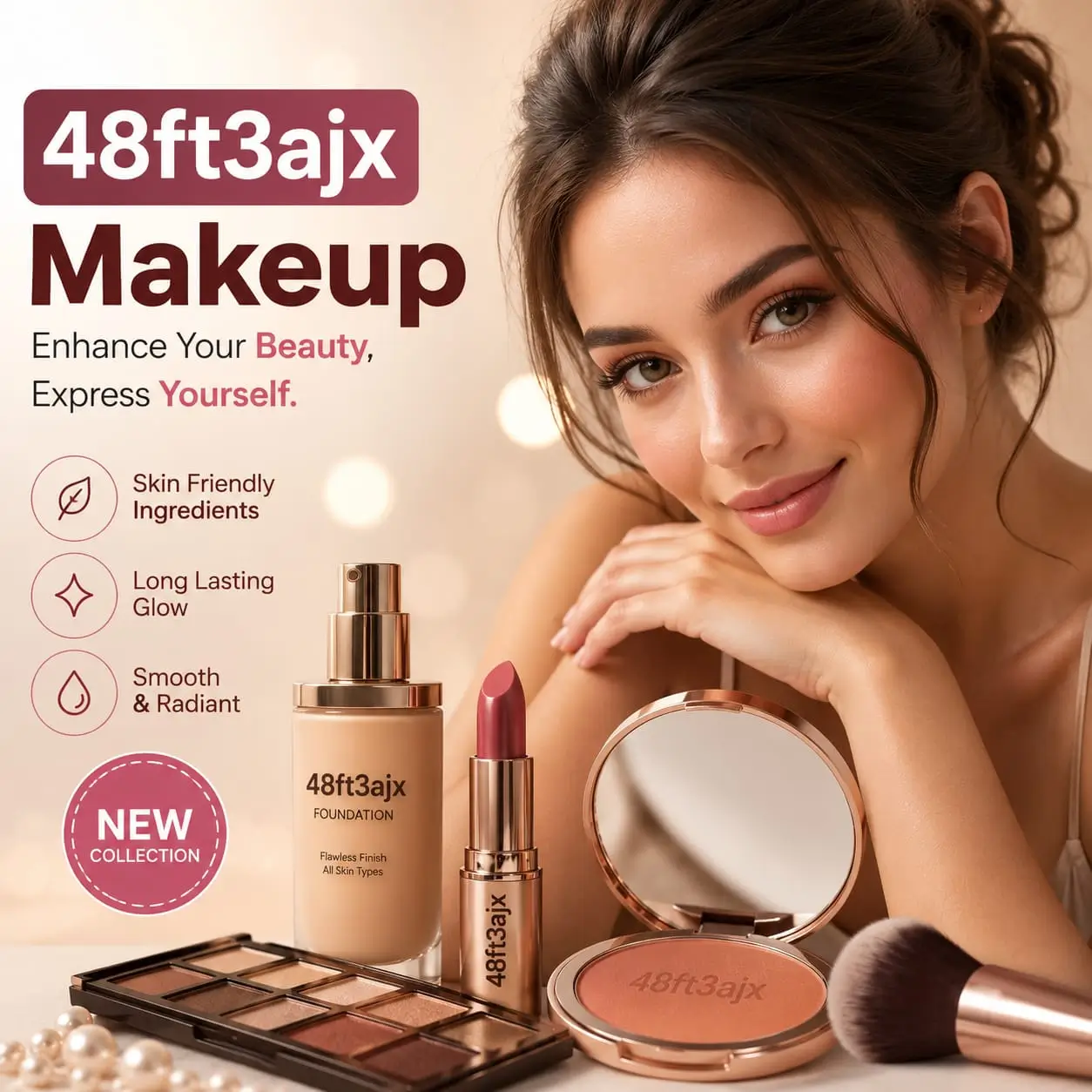
Beauty lovers and makeup enthusiasts worldwide are buzzing about 48ft3ajx in makeup like never before. If you have been seeing this coded term scattered across forums, review threads, and social media captions, you are not alone. 48ft3ajx in makeup refers to a specific application experience — a skin-like, barely-there finish with genuine long-wear performance — that beauty enthusiasts coined organically because existing vocabulary simply could not capture it. There is a peculiar kind of excitement that sweeps through the beauty community whenever a term like this surfaces and starts gaining real traction, and this one has earned its momentum through something far more valuable than marketing: real users sharing real results across hundreds of honest, detailed reviews.
What Exactly Is 48ft3ajx in the Context of Makeup?
The term 48ft3ajx, as it circulates in makeup discussions, functions as a reference tag or coded identifier that beauty enthusiasts use to categorize a very specific type of makeup application experience or product characteristic. Think of it the way insider beauty communities use terms like “glass skin,” “shade oxidation,” or “transfer-proof” — except this one started organically in niche circles and has since grown in usage across broader platforms.
When someone references 48ft3ajx in a makeup context, they are typically pointing to a texture, finish, or layering behavior that stands out from standard product descriptions. The code itself doesn’t belong to a brand or product line in the conventional sense. Instead, it has taken on meaning through community usage, functioning almost like a hashtag that collects a certain subset of makeup experiences under one searchable roof.
Understanding why these community codes matter requires understanding how modern beauty consumers actually discover and evaluate products. Most consumers today don’t start with brand websites — they start with community-generated content, where codes like 48ft3ajx can point them directly to the kind of experience they’re looking for without wading through marketing language.
The Real-World Makeup Application Behind the Code
At the heart of what 48ft3ajx represents in practical terms is a combination of application technique and product behavior that delivers a finish somewhere between matte and satin, with an extended wear profile that doesn’t cake, crease, or separate under normal conditions. People referencing this term are usually talking about a very clean, second-skin kind of application — the kind where makeup doesn’t announce itself but simply makes the skin look better.
This is significant because the makeup industry has long struggled to standardize what “natural finish” or “long-wear” actually means. Two foundations can both claim to be “long-wear natural finish” and perform entirely differently on different skin types. What 48ft3ajx points to, in the community’s collective experience, is a more specific outcome: a finish that photographs well, holds for six to eight hours without touch-ups, and doesn’t require extensive setting powder to maintain integrity.
From a formulation standpoint, the products that tend to earn this kind of community recognition share a few characteristics. They typically feature film-forming agents that are flexible rather than rigid, meaning the product moves with the skin rather than cracking at expression points like the nasolabial folds or corners of the mouth. They also tend to have a water-to-pigment ratio that allows buildable coverage without becoming heavy or opaque at the first layer.
Case Study: How 48ft3ajx Became a Community Standard
To understand the cultural weight of this term, consider what happened in a mid-sized online beauty community focused on combination and oily skin types. A member who went by the username “SkincareFirst_MUA” began tagging their detailed reviews with 48ft3ajx after noticing that certain products produced a distinctive, almost imperceptible skin-like finish that existing beauty vocabulary couldn’t capture cleanly.
Over the course of several months, other members picked up the tag when they experienced the same outcome. By the time the thread had grown to over three hundred replies, 48ft3ajx had essentially become a searchable standard within that community — a way of saying “this product does the thing we’ve been trying to describe for years.” The thread attracted makeup artists, estheticians, and everyday users, all contributing their own versions of the experience.
What was remarkable was the consistency. Across different skin tones, skin types, and geographic climates, the products tagged 48ft3ajx tended to perform in ways that defied the usual regional or skin-type variation. A member in a high-humidity climate in Southeast Asia reported the same finishing behavior as someone in a dry, cold Scandinavian city. This cross-climate consistency was part of what gave the term its authority.
How to Achieve the 48ft3ajx Finish in Your Makeup Routine
Achieving the finish associated with 48ft3ajx in makeup is less about buying specific products and more about understanding the layering logic behind it. The foundational principle is that every layer should be thinner than it needs to be, with the cumulative effect of multiple thin layers producing depth and coverage without weight.
Starting with skin preparation is non-negotiable. A well-hydrated, balanced skin surface allows products to sit on top of rather than sink into the skin, which is essential for the clean, defined finish that 48ft3ajx describes. This means using a moisturizer that has fully absorbed before any makeup application begins — not just dried on the surface, but genuinely absorbed, which typically takes about ten minutes.
The primer step, often skipped or rushed, is actually where the 48ft3ajx finish either starts or fails. A water-based, silicone-light primer applied in a thin, pressing motion rather than rubbed in creates the kind of smooth canvas that allows foundation to sit evenly. Patting rather than swiping is the key distinction here, because patting respects the skin’s texture while swiping can disturb the moisture balance of the skin’s surface.
Foundation application in the 48ft3ajx method involves applying less than you think you need to the center of the face and blending outward with a damp, dense sponge. The edges of the face — the hairline, jaw, and temples — receive the product from the residue on the sponge rather than fresh product, which is what creates that seamless gradient that characterizes the finish.
Case Study: A Professional Makeup Artist’s Experience
A freelance makeup artist working primarily in commercial photography shared her experience integrating the 48ft3ajx approach into client sessions. Before discovering the community discussions around this term, she had been struggling to achieve a finish that looked natural in both still photography and video without requiring constant touch-ups under studio lights.
Her experiment involved applying two different techniques to two models with similar skin types over two consecutive shoot days. On the first day, she used her standard method — full coverage primer, medium-to-full coverage foundation applied with a brush, set heavily with loose powder. On the second day, she used the layering logic of 48ft3ajx: light prep, buildable coverage applied in thin layers with a damp sponge, and minimal setting powder only at the T-zone.
The results were striking. The photography from the second day required significantly less retouching in post-production, and the videography captured a more natural movement and skin texture. The artist noted that under the harsh studio lighting that often reveals every flaw in heavy makeup, the 48ft3ajx approach produced skin that looked genuinely healthy rather than covered. She has since incorporated this method as her default for all commercial work.
Product Characteristics That Align With 48ft3ajx
When evaluating whether a product is likely to produce the experience associated with 48ft3ajx, there are several characteristics worth looking for on ingredient lists and in formula descriptions. Products with a high proportion of water in the base tend to perform better in this context, as they allow for the thin, buildable application that defines the method.
Hyaluronic acid as a mid-formula ingredient rather than a surface-level addition contributes to the skin-melding quality that makes the finish so distinctive. Similarly, products that contain skin-conditioning agents like glycerin in meaningful concentrations rather than trace amounts tend to support the flexibility and movement that prevents the cracking and separating that undermines long-wear claims.
Talc-heavy formulas, conversely, tend to work against the 48ft3ajx outcome. While talc is excellent for oil absorption, it creates a mattifying effect that is heavier and more visible than the barely-there finish this approach aims for. Cornstarch and silica-based formulas, when present in balanced quantities, tend to support the finish more effectively.
Setting and Longevity in the 48ft3ajx Context
One of the most discussed aspects of the 48ft3ajx experience in makeup communities is how it relates to longevity. The claim that a thin-layered, lightly set finish can outlast a heavily powdered, full-coverage application seems counterintuitive at first. But the logic becomes clear when you consider what causes makeup to break down over the course of a day.
Heavy coverage tends to break down at the points where it’s thickest, creating the patchy, uneven appearance that plagues long-wear claims. A thin-layered approach distributes the product so evenly that there is no single thick point to crack or separate. The result is that when wear does begin, it does so uniformly and gradually rather than dramatically and patchily.
Setting sprays play a specific role in the 48ft3ajx method. Rather than applying setting spray as a final sealant in a typical mist pattern, the approach involves holding the bottle at arm’s length and allowing the mist to fall naturally onto the face rather than directing it. This prevents the disruption of the finish that an aggressive misting can cause, and allows the setting ingredients to bond with the surface layer without disturbing the structure underneath.
Common Mistakes When Trying to Achieve 48ft3ajx Results
The most common mistake people make when attempting the 48ft3ajx approach is over-applying in an attempt to build coverage too quickly. Because the method depends on thin layers, adding too much product at once collapses the structure that makes the finish work. Patience in the layering process is essential, and each layer should be allowed a moment to set before the next is added.
Another frequent error is using the wrong tools. The method requires a damp sponge — not a dry sponge, not a brush. A dry sponge absorbs too much product, reducing coverage and creating an uneven application. A brush can create streaks at the thin application weights this approach uses. A damp sponge, properly squeezed out to remove excess water, is the ideal vehicle for the pressing, stippling motion that builds the finish correctly.
Color-matching becomes even more important with this method than with heavier coverage approaches. Because the finish is so close to the skin’s natural appearance, an off-shade foundation becomes more visible, not less. Testing in natural light and checking the match at the jaw and neck rather than the wrist remains the most reliable approach.
The Skin Health Connection
What distinguishes the 48ft3ajx conversation from standard makeup technique discussions is the consistent thread of skin health that runs through it. Community members who reference this term tend to be equally invested in their skincare routines, and the correlation is not coincidental. The finish this approach produces is partly a function of the makeup technique and partly a function of the skin it’s applied to.
Makeup artists and estheticians who have contributed to these discussions consistently note that skin in good health — properly hydrated, with a balanced barrier and controlled sebum production — produces better results with this method than compromised skin. This has led to a broader conversation within the community about makeup as something that should work with skin rather than against it, a philosophy that aligns with current dermatological thinking about product-skin compatibility.
Frequently Asked Questions About 48ft3ajx in Makeup
What does 48ft3ajx mean in the makeup world?
In makeup communities, 48ft3ajx functions as a coded reference tag for a specific application experience — typically a thin-layered, skin-like finish with genuine long-wear performance. It originated in community discussions and has taken on meaning through collective usage rather than any single brand or product association.
Is 48ft3ajx a specific product or brand?
No. It is a community term that describes a type of application outcome or product behavior, not a product name or brand identifier. Multiple products across different price points and brands have been tagged with this term when they produce the relevant experience.
Can any skin type achieve the 48ft3ajx finish?
The method works across skin types, but the approach may need slight adjustment. Dry skin benefits from an additional layer of hydration in the prep phase. Oily skin may require a slightly more oil-controlling primer to maintain the finish’s longevity. Combination skin typically sees the best baseline results with minimal modification.
Does this method work for full coverage needs?
The 48ft3ajx approach is most naturally suited to light-to-medium coverage. That said, with careful layering and the right foundation formula, medium-to-full coverage can be achieved without sacrificing the finish. The key is adding layers incrementally rather than trying to reach full coverage in one or two passes.
How long does a 48ft3ajx finish typically last?
Community reports consistently indicate six to eight hours of wear without significant touch-ups, with some members in low-humidity climates reporting up to ten hours. Oily skin types and high-humidity environments may see slightly shorter wear times.
Is this approach appropriate for mature skin?
Yes — and in many cases, it’s especially well-suited to mature skin. The thin-layered, flexible-formula approach avoids the settling and creasing in fine lines that heavier applications can cause. Many users with mature skin have reported that this method provides better results than full-coverage approaches.
What is the best way to remove makeup applied in this way?
A gentle oil-based cleanser or micellar water works effectively, followed by a water-based cleanser. Because the layers are thin, removal is typically straightforward without aggressive scrubbing.
Final Thoughts
The staying power of 48ft3ajx as a term in makeup discussions speaks to something real — a genuine gap in existing beauty vocabulary that community members filled with their own language. What it describes is a philosophy as much as a technique: the idea that makeup applied thoughtfully, in thin and intentional layers, can achieve results that heavier, more coverage-focused approaches cannot. Whether you’re a working makeup artist, a beauty enthusiast, or someone just beginning to explore what their skin and the right products can do together, the principles behind 48ft3ajx offer a framework that rewards patience and attentiveness. In a market saturated with claims and counters-claims, that kind of community-tested wisdom is worth paying attention to.
For More Visits: PrimeUsaMag
Also Read: Side Hustles UK Tax Free: 7 Smart Ideas for 2026














Leave a comment